
Introduction
Water pollution is a significant environmental challenge particularly floating plastic waste and debris. To address this issue on pond, this project introduces a River Cleaning Boat which is a floating mechanical device designed to actively collect surface waste from water bodies.
Definition and Type of Concept
Our project operates on a conveyor belt mechanism using a net to lift floating debris out of the water and deposit it into an waste collector. The boat relies on direct current (DC) for propulsion and waste collection, utilizing paddle wheels for forward motion and a rotating mesh net for skimming.
Core Scientific Concepts and Formulas
The design and operation of the boat rely on two primary physics concepts:
- Buoyancy (Archimedes’ Principle): For the boat to float the upward buoyant force must equal the total downward gravitational force (weight) of the boat. We used bottles and sunboard to displace enough water to achieve this balance.
The formula for buoyant force is:
Fb =volume x density x gravitational acceleration Where Fb is the buoyant force
- Electrical Power and DC Circuits: The boat’s movement and net rotation are powered by a DC circuit. The total electrical power consumed by the four motors is given by:
P = VI
Where P is power in watts V is voltage from the batteries and I is the total current drawn by the motors
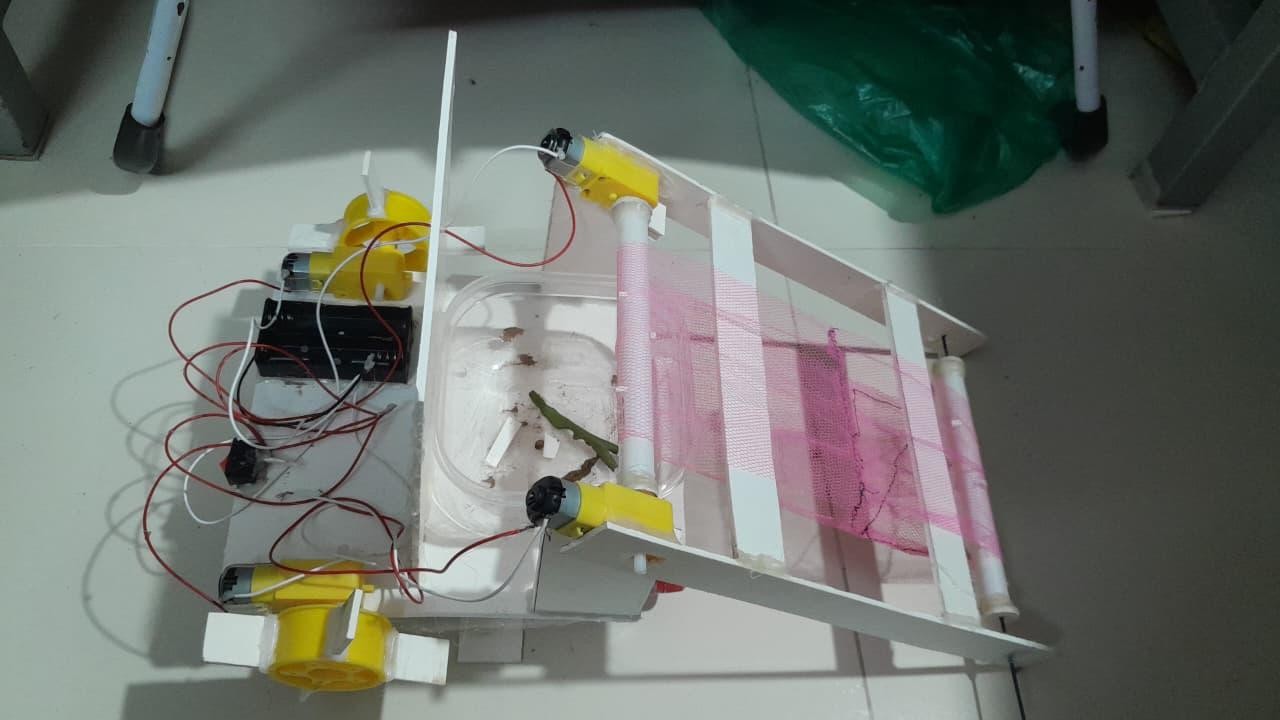
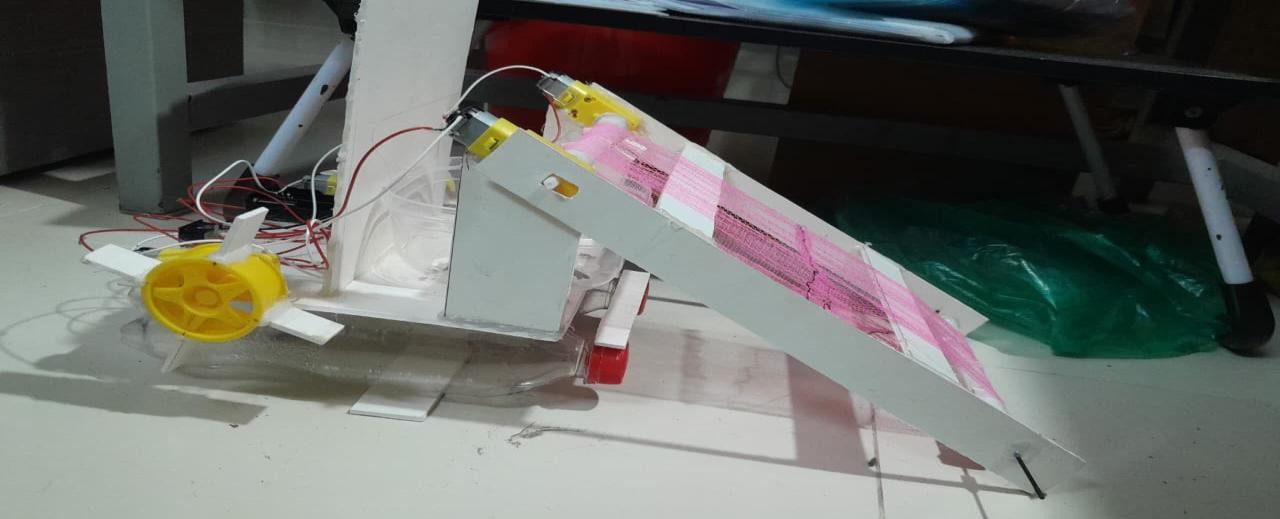
FIG 1: TOP VIEW & SIDE VIEW
Methodology
The construction of the boat was divided into two main functional parts: the propulsion system and the waste collection system.
Materials Used
| Component | Quantity | Purpose in Project |
| Sunboard | Multiple pieces | To build the lightweight main chassis and paddle fins. |
| Plastic Bottles | 3 | Placed under a piece of sunboard to provide additional buoyancy. |
| 3.7v lithium Batteries | 2 | To provide the voltage and current to run the system. |
| DC Gear Motors | 4 | Two for the rear paddle wheels; two for the front net rollers. |
| Pipes & Net | 2 pipes, 1 net | Acts as the rotating conveyor belt to skim |
| Plastic Container | 1 | Serves as the waste collection box in the center. |
| Switch & Wiring | 1 set | To control the master power circuit. |
Construction Steps
- Chassis Design: The boat was built in two joined sections using lightweight sunboard to ensure it remains buoyant.
- Propulsion Section (Rear): Two DC motors were mounted at the back. We attached custom made sunboard fins to round wheels to create paddle wheels. The two 3.7v lithium batteries and the main power switch were installed in this rear section.
- Collection Section (Front): Two additional DC motors were mounted on angled sunboard arms. Small diameter pipes were connected to these motors. A mesh net was stretched tightly between the pipes to act as a rotating skimmer.
- Assembly and Balancing: The waste collector box was positioned in the center. The front and rear sections were joined carefully. As seen in fig 1, the heavy batteries in the rear help counterweight the extended motor arms in the front, keeping the center of mass stable so the boat floats evenly.
Result
After turning on the control switch the power is successfully delivered to all four motors simultaneously. The rear paddle wheels rotate, propelling the boat forward through the water. The front motors rotate the small pipes driving the net in a continuous loop. As the boat moves
forward the submerged part of the net taking up floating debris, carries it up the incline and drops it into the waste collector.
The prototype successfully demonstrates an automated river cleaner.
- Strengths: The dual purpose use of DC motors keeps the circuit simple and efficient. The use of a mesh net allows water to pass through freely while trapping solid waste, reducing drag on the boat.
- Observations on Balance: A critical challenge in this design was maintaining equilibrium. Because the front conveyor system extends outward and upward, it creates a moment. By placing the heavy batteries and the center of buoyancy correctly the boat achieves static equilibrium, preventing it from sink into the water.
The River Cleaning Boat project successfully proves that a low cost mechanical device can effectively collect floating waste from water surfaces. By applying the principles of buoyancy and basic power system we created a functional prototype that solves a real world environmental issue.
Future Scope:
While the current model operates on a single switch continuous forward motion, future iterations could include:
- An RC (Remote Control) receiver and independent motor control for steering capabilities.
- Solar panels to recharge the batteries during daylight operation.
- Ultrasonic sensors to allow the boat to autonomously avoid riverbanks and large obstacles.
Range of resources –involves the use of diverse resources (people, money, equipment, materials, information and technologies).
| Resources | Report components |
| Materials | Pvc pipe, sun board strips, straw, cycle spoke, glue stick , net, garbage collector , electrical wire |
| Equipment | Hot glue gun, anti-cutter, battery case |
| Technologies | DC motor, switch, 3.7v lithium battery |
| People | Project group members |