
Introduction
Flow visualization is one of the most important experimental techniques in fluid mechanics, as it helps to understand the behavior of fluid flow around different objects. It allows engineers and researchers to observe streamlines, flow separation, wake formation, and vortex structures that cannot be seen with the naked eye.
Commercial water channels used for flow visualization are often expensive and not easily available in undergraduate laboratories. Therefore, this project aims to design and develop a low-cost water channel using locally available materials for educational and experimental purposes.
During the project, several engineering challenges were encountered, including unstable laminar flow, backflow generation, vortex formation due to channel geometry, and rapid diffusion of visualization dyes. Different channel configurations, flow straighteners, and visualization materials were tested to improve the flow quality. Food color and marker ink were found to diffuse quickly in water, while acrylic paint produced clearer and more stable streamlines.
The developed water channel successfully generated nearly laminar flow and enabled the visualization of flow around cylindrical and airfoil models. The experimental setup provides a simple, economical, and effective platform for studying fundamental fluid mechanics phenomena and can be used for academic demonstrations and laboratory experiments
Methodology
- Water channel :
- Water channel was made by UPVC sheet . the main test area was 60 cm long and 11.43 cm width and 11.43 cm hight .
- Before the test section a trapezium shaped settling chamber for the flow to be smoother .
- To reduce the backflow from the back of the test section a spiral section was introduced to the design .
- Pump inlet was set on the middle of the spiral area and the outlet was set on the settling chamber
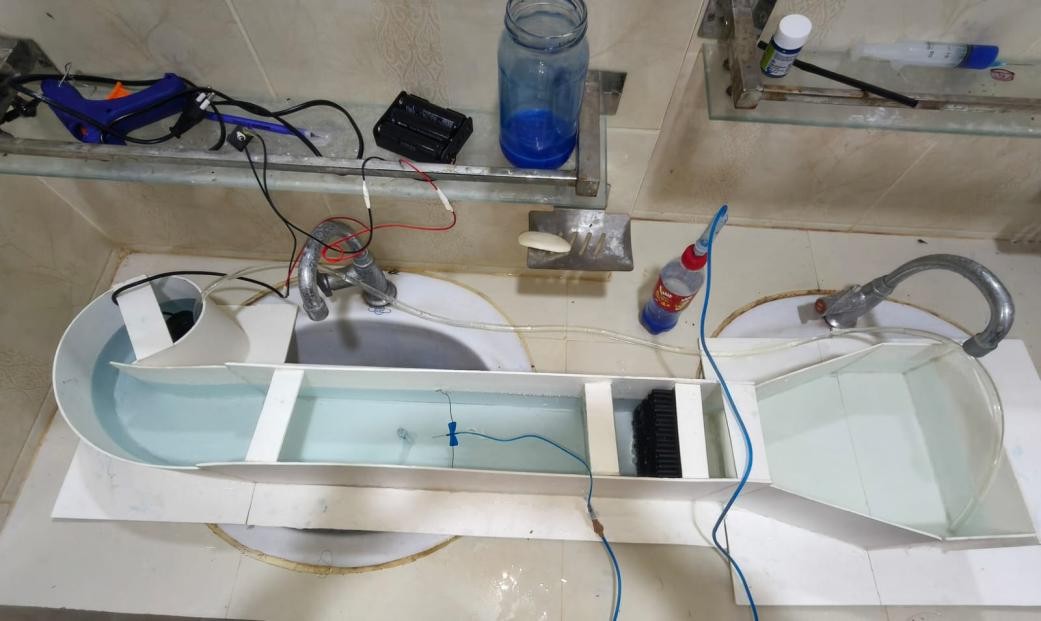
Fig: Setup of a Water channel for flow visulaization.
Honey comb :
- Honey comb was made by stacking a bunch of straw pipe togather in a shape of honey comb
Mesh :
- Mosquto net was used to make the mesh filter
Aerofoil :
- Aerofoil was 3d designed by solid works with proper dimentioning and printed by a 3d printer
Results
The project was completed successfully. At first, we faced some problems like turbulent flow, backflow, and color mixing with water. We changed the channel design several times to get better laminar flow. We also tested different colors. Food color and marker ink mixed quickly with water, but acrylic paint gave better results. Finally, we were able to see the flow around the cylinder and airfoil clearly. This low-cost water channel can be used for learning and basic fluid flow experiments.
Conclusion
This project successfully developed a low-cost water channel for flow visualization. After several design changes, we achieved nearly laminar flow and observed the flow around a cylinder and an airfoil. Acrylic paint gave better visualization than food color and marker ink. The final setup is simple, low-cost, and useful for fluid mechanics experiments and educational purposes.
Uses of diverse resources such as equipment, people, software, materials, money, and technologies.
|
Resources |
Project Components |
|
Materials |
UPVC sheet, Rubber pipe, acrylic paint, adhesive |
|
Equipment |
Water pump, syringe, honeycomb flow straightener, cylinder and 3D printed airfoil |
|
Technologies |
3D printing, flow visualization technique |
|
Laboratory & People |
Fabrication, assembly, testing and experimental observation |