Fluid basics

Fluid, Fluid basics, Fluid Dynamics

Triangular Notch (V-Notch)

Triangular V-notch weirs are a fundamental tool in hydraulic engineering, providing a cost-effective and reliable method for measuring flow in open channels. Accurate flow measurement is essential for managing water resources, monitoring the environment, and conducting hydraulic research. These weirs operate on the principle that the flow rate is related to the opening angle of

Fluid, Fluid basics, Fluid Dynamics

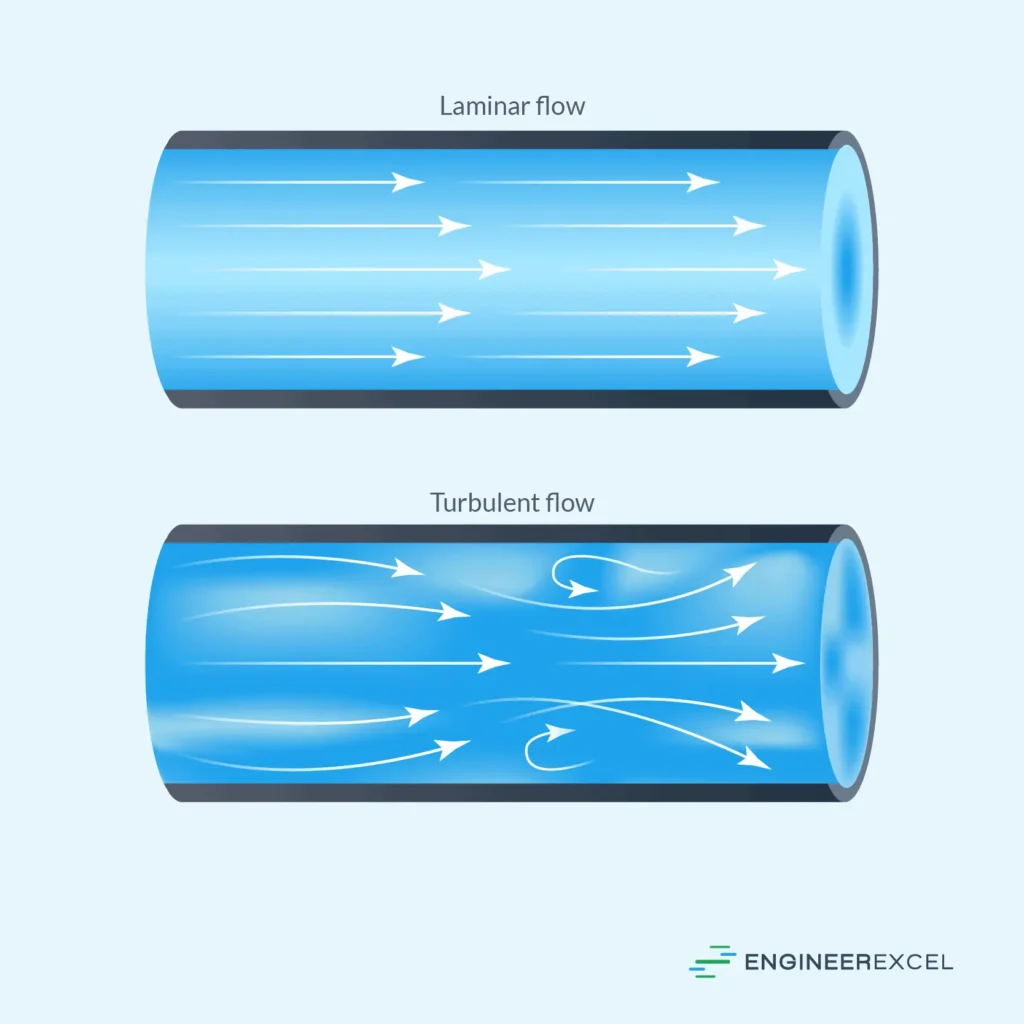
LAMINAR AND TURBULENT FLOWS

If you have observed cigarette smoke, you may have noticed that it initially rises as a smooth, steady plume before beginning to fluctuate erratically as it moves upward. Similar behavior occurs with other plumes. This phenomenon mirrors observations in pipe flow: at low velocities, the flow is smooth and orderly, but above a certain critical

Fluid, Fluid basics

Incompressible Flow

The general conservation of mass equations can be further simplified for incompressible flows, a condition typically applicable to liquids. Since density (ρρ) is constant, it can be canceled from both sides of the general steady-flow relation, yielding: Steady, incompressible flow:∑inV˙=∑outV˙where V˙˙ is the volume flow rate. For a system with a single inlet and a single outlet, this

Fluid, Fluid basics, Study

What Is a Fluid?

What Is a Fluid? You will recall from physics that a substance exists in three primary phases: solid, liquid, and gas. (At very high temperatures, it also exists as plasma.) A substance in the liquid or gas phase is referred to as a fluid. Distinction between a solid and a fluid is made on the

Scroll to Top