
Introduction
Standing hundreds of meters above the ground, modern wind turbines have become one of the most recognizable symbols of renewable energy. Despite decades of technological advancement, one design feature has remained remarkably consistent: almost every utility-scale wind turbine has three blades. This raises an interesting engineering question—if more blades capture more wind, why don’t modern wind turbines have four, five, or even ten blades?
The answer lies in a careful balance between aerodynamics, structural mechanics, economics, and energy efficiency. Contrary to popular belief, the goal of a wind turbine is not to capture the maximum amount of wind but to extract energy from the wind as efficiently and reliably as possible. The three-bladed design represents the result of decades of research, optimization, and engineering trade-offs.
Wind Energy Conversion
A wind turbine converts the kinetic energy of moving air into electrical energy. As wind flows over the blades, each blade behaves like an aircraft wing. Instead of relying mainly on drag, modern turbines generate lift, which causes the rotor to rotate. The rotating shaft drives a generator that produces electricity.
The amount of power available in the wind depends on wind speed. Because wind power increases with the cube of wind velocity, even a modest increase in wind speed can significantly increase power generation. However, extracting that energy efficiently depends largely on blade design.
Why Not More Blades?
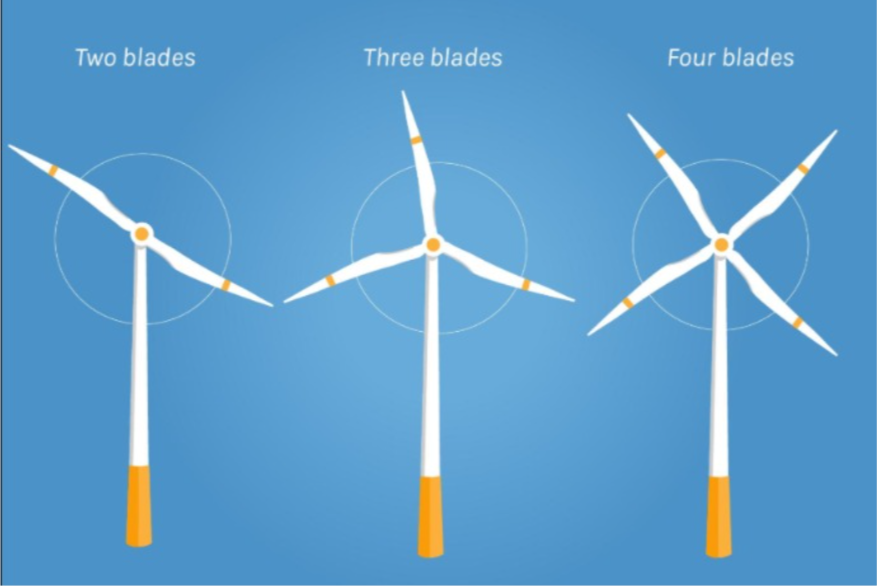
At first glance, adding more blades appears beneficial because a larger portion of the rotor area interacts with the wind. However, this intuition overlooks several aerodynamic effects.As the number of blades increases, each blade creates a disturbed airflow, known as its wake. Additional blades increasingly operate in this disturbed air, reducing the overall aerodynamic efficiency of the rotor. More blades also increase rotor weight, manufacturing costs, maintenance requirements, and structural loads on the tower and drivetrain.
Conversely, using too few blades presents another challenge. A single-bladed turbine requires a large counterweight for balance, while a two-bladed turbine experiences greater vibration and cyclic loading, making operation less stable.
Through decades of aerodynamic testing and field experience, engineers found that three blades provide the best compromise between efficiency, structural stability, noise, and cost.
The Role of Airfoil Design
A wind turbine blade is not simply a long flat surface. It is carefully shaped using specialized airfoil profiles, similar to those used on aircraft wings. These airfoils generate lift while minimizing drag, allowing the rotor to produce more power from the same wind speed.
Interestingly, the blade shape changes from root to tip. Near the hub, the blade is thick and strong to withstand high bending moments. Toward the tip, it becomes thinner and more streamlined to improve aerodynamic efficiency. The blade is also twisted because the relative wind angle changes along its length. This twist ensures that each section of the blade operates close to its optimum angle of attack.
Airfoils: The Hidden Technology Behind Wind Turbine Efficiency
Although the towering blades of a wind turbine attract most of the attention, the true secret to their performance lies in a much smaller feature—the airfoil. Every cross-section of a modern wind turbine blade is designed as an airfoil, similar in principle to an aircraft wing. As wind flows around the airfoil, the pressure difference between its upper and lower surfaces generates lift, causing the rotor to spin. Unlike drag-based devices, lift-driven turbines extract energy more efficiently, allowing them to generate greater power even at moderate wind speeds.Selecting the appropriate airfoil is one of the most critical decisions in wind turbine design. Engineers evaluate several aerodynamic characteristics, including the lift coefficient (Cₗ), drag coefficient (Cₑ), lift-to-drag ratio (L/D), stall behavior, and structural strength. A well-designed airfoil produces high lift while minimizing drag, maximizing the amount of wind energy converted into mechanical rotation.Modern wind turbine blades do not use a single airfoil profile from root to tip. Instead, they incorporate multiple airfoil families along the blade length. Thick airfoils near the hub provide structural strength to withstand large bending loads, while thinner, more streamlined airfoils toward the blade tip reduce aerodynamic drag and improve efficiency. This gradual variation enables the blade to maintain optimal aerodynamic performance despite changes in relative wind speed and flow angle.
Another important design feature is blade twist. Because the blade tip travels much faster than the root, the angle at which the wind meets the blade varies along its span. Engineers carefully twist the blade so that each airfoil section operates close to its optimum angle of attack, maximizing lift while delaying flow separation and stall.

Recent research has also explored biomimetic airfoils inspired by nature. Leading-edge tubercles modeled after humpback whale flippers can improve stall resistance, while serrated trailing edges inspired by owl wings reduce aerodynamic noise. Such innovations are being investigated to develop quieter, more efficient, and more environmentally friendly wind turbines.As computational fluid dynamics (CFD), artificial intelligence, and advanced composite materials continue to evolve, future airfoil designs are expected to become increasingly adaptive and optimized for varying wind conditions. Rather than relying on a fixed geometry, next-generation wind turbine blades may adjust their aerodynamic characteristics in real time, achieving higher energy capture while reducing structural loads and maintenance costs.


Balancing Performance and Cost
Engineering is rarely about maximizing a single parameter. Instead, it involves balancing multiple objectives simultaneously.
A four- or five-bladed turbine may appear capable of capturing more wind, but the additional energy gained is usually too small to justify the increased manufacturing costs, transportation challenges, installation complexity, and maintenance expenses. On the other hand, reducing the number of blades lowers costs but sacrifices stability and increases fatigue loading.
The three-bladed configuration achieves an excellent balance between energy production, structural integrity, visual appearance, and long-term economic performance.
Modern Innovations in Wind Turbine Design
Although the number of blades has remained largely unchanged, wind turbine technology continues to evolve rapidly. Modern research focuses on improving blade performance rather than increasing blade count.
Some emerging innovations include:
- Biomimetic blade designs inspired by humpback whale flippers and owl wings.
- Lightweight composite materials that improve strength while reducing weight.
- Artificial intelligence for predictive maintenance and performance optimization.
- Smart sensors that continuously monitor blade health.
- Adaptive pitch control systems that maximize power under varying wind conditions.
- Recyclable blade materials to reduce environmental impacts at the end of a turbine’s life.
These innovations aim to improve energy capture while maintaining the advantages of the three-bladed configuration.
Environmental and Engineering Significance
Wind turbines contribute significantly to reducing greenhouse gas emissions and dependence on fossil fuels. However, designing an efficient turbine requires more than simply increasing its size or adding more blades. Every design decision involves trade-offs among aerodynamics, structural mechanics, economics, manufacturability, reliability, and environmental impact.
The widespread adoption of the three-bladed wind turbine demonstrates that the best engineering solution is often not the one that appears most obvious. Instead, it is the one that delivers the highest overall performance when all technical and practical factors are considered together.
Conclusion
The three-bladed wind turbine is not the result of tradition or aesthetics but of careful engineering optimization. It reflects decades of research into aerodynamics, materials, structural mechanics, and economics. As renewable energy technologies continue to advance, future turbines will become smarter, lighter, and more efficient. Yet the enduring success of the three-bladed design reminds us that the most effective engineering solutions are those that achieve the best balance among performance, reliability, sustainability, and cost rather than simply maximizing a single characteristic.