
Introduction
Renewable energy has become increasingly important due to the growing demand for clean and sustainable power sources. Wind energy is one of the most widely used renewable energy resources because it is environmentally friendly and readily available. A Vertical Axis Wind Turbine (VAWT) converts the kinetic energy of wind into mechanical and electrical energy. This project aims to design and fabricate a small Savonius-type VAWT to demonstrate the principles of fluid mechanics, drag force, and energy conversion. It also provides practical knowledge of wind turbine design and renewable energy systems.
Methodology
A Savonius-type vertical axis wind turbine was fabricated using PVC pipe blades mounted on a vertical shaft. Bearings were used to reduce friction, and a DC motor was connected to the shaft to generate electricity. The turbine was placed in front of an electric fan, which supplied airflow to rotate the blades. As wind struck the curved blades, a drag force was created, causing the rotor to rotate and produce electrical energy.
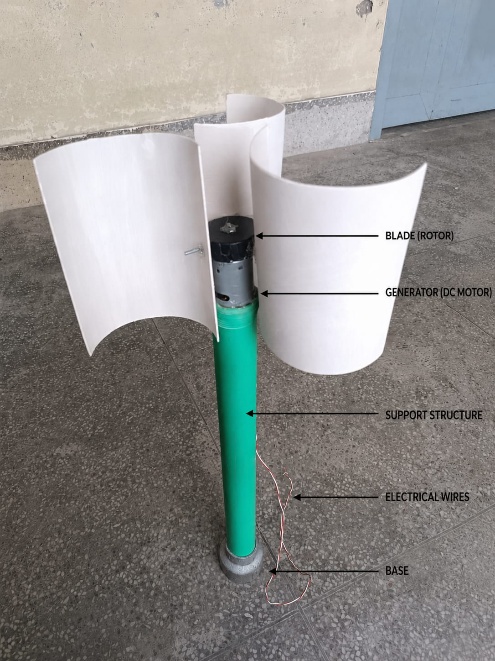
Figure: Developed Experimental Setup
Results
The fabricated wind turbine rotated successfully when exposed to airflow. An external source was also used due to poor airflow. The rotational speed increased with higher wind velocity, resulting in greater electrical output from the DC generator. The project demonstrated the practical application of drag force and wind energy conversion. Proper blade alignment and reduced friction improved the turbine’s performance, while higher wind speeds produced better efficiency. The model effectively illustrates the working principle of a vertical axis wind turbine.
Conclusion
The project successfully demonstrated the conversion of wind energy into electrical energy using a Savonius Vertical Axis Wind Turbine. It verified the application of fluid mechanics concepts such as drag force and energy conversion. The fabricated model is simple, cost-effective, and suitable for educational purposes. With improved blade design and better materials, the turbine’s efficiency can be further enhanced.
Uses diverse resources such as equipment, people, software, materials, money, laboratories, and technologies.
|
Resources |
Project components |
|
Materials |
DC motor, PVC pipe, bearings, PVC end caps, nuts, bolts, screws, wires |
|
Equipment, People |
Drill machine, hacksaw, screwdriver, marker, ruler, soldering iron, pliers, team members |