
INTRODUCTION
Flow pattern around a cylinder occurs when the boundary layer, slowed by viscous friction, cannot overcome the adverse pressure gradient encountered along the rear surface. As fluid moves past the cylinder’s maximum thickness, it decelerates, causing the pressure to rise in the direction of flow. This pressure increase forces the boundary layer to detach from the surface, creating a low-pressure wake region behind the cylinder.
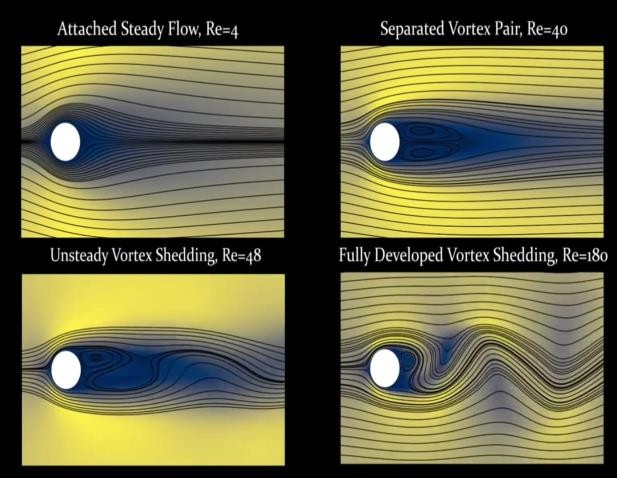
This separation is the primary cause of pressure drag, as the pressure at the rear remains significantly lower than at the front. The detached shear layers become unstable and roll up into vortices, which are then shed into the downstream flow.
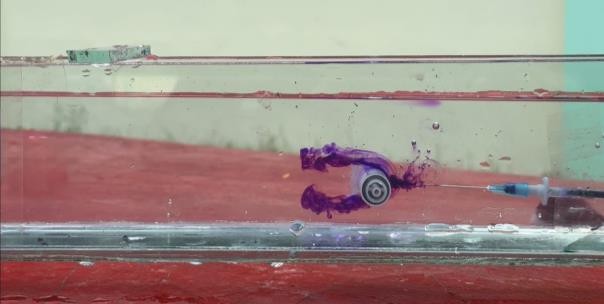 In laminar flow, separation typically occurs near the top and bottom of the cylinder, while in turbulent flow, the increased momentum of the fluid allows the boundary layer to remain
attached longer, shifting the separation point further downstream.
The dye used to visualize this process by highlighting the separation points, the recirculating wake, and the shear layers that define the flow’s transition from attached to separated.
As the flow speed increases, the frequency of vortex shedding also increases, as the rate of fluid transport and shear layer instability scales with
the free-stream velocity. This relationship is often characterized by the Strouhal number (St = fD/v), which indicates that the vortex shedding frequency (f) is directly proportional to the flow velocity (v).
METHODOLOGY
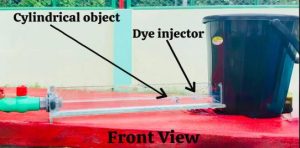
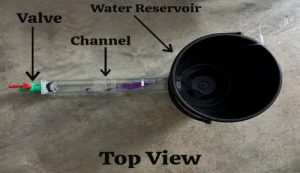
- The experimental setup consisting of a water reservoir, transparent flow channel, cylindrical object, control valve, and dye injector was assembled as shown in the figures.
- The water reservoir was filled with water, and the valve was adjusted to establish a steady and uniform flow through the channel.
- A small quantity of dye was injected upstream of the cylindrical object to visualize the flow pattern.
- The dye stream was observed as it flowed around the cylinder, and the development of flow separation, wake formation, and vortices was recorded.
RESULT
- The flow approached the cylinder smoothly before encountering its surface.
- A stagnation point was observed at the front of the cylinder where the fluid velocity became nearly zero.
- The flow accelerated along both sides of the cylinder.
- Boundary layer separation occurred on the downstream side of the cylinder.
- A wake region was formed behind the cylinder due to flow separation.
- Vortex formation was observed in the wake region, as indicated by the dye pattern.
The experiment was conducted to observe the flow pattern around a circular cylinder using dye injection. The dye streamlines clearly illustrated the behaviour of the fluid as it approached and passed around the cylinder. A stagnation point was observed at the front of the cylinder, where the fluid velocity was nearly zero. As the flow moved along the curved surface, its velocity increased and the pressure decreased in accordance with Bernoulli’s principle.
On the downstream side of the cylinder, the boundary layer separated from the surface due to the adverse pressure gradient. This resulted in the formation of a wake region behind the cylinder, where vortices were observed through the dye pattern. The wake indicated energy loss and increased drag caused by flow separation.
CONCLUSION
The study of flow around a cylinder reveals that separation and vortex shedding are complex, velocity-dependent phenomena that significantly influence the forces acting on a body. By recognizing the relationship between flow speed, boundary layer state, and vortex frequency, engineers can better predict and mitigate the risks associated with fluid-induced vibrations, ensuring the safety and longevity of structures exposed to fluid flow.