
Community Posts
Reducing friction in engineering workflows from CAD to manufacturing
Today’s manufacturing process relies on seamless digital handoffs from design to simulation to production. But engineers spend more time fighting data than designing – converting CAD files, repairing geometry and prepping meshes all take time away from designing. This is…
9 Great Projects for Engineers With Household Items
Engineers have a knack for making everyday household items unique creations. Be it a catapult, a trebuchet, or something else entirely, the possibilities are truly endless. With the right tools, a bit of imagination, and some knowledge of physics, engineering…
Five Ways Engineers Can Prepare for the Fourth Industrial Revolution
The world of engineering is at the gates of a technological revolution that will very much change our lives in every way, from our work and education, to our entertainment and relationships. The first of many industrial revolutions arrived when…

Zero Energy Buildings
Most buildings around the world – residential, commercial or industrial – use a lot of energy during their lifetime, whether for lighting, heating, ventilation systems or plugged-in devices. In fact, buildings use about 40% of global energy, 25% of global…

ESA’s Euclid Space Telescope Finds Universe’s Most Ancient Quasars
This artist’s concept shows a quasar, which is a galaxy with large quantities of material spiralling into its central supermassive black hole. Extreme gravitational and frictional forces heat the material to millions of degrees, generating more light than all the…
NASA’s COFFIES Science Center Makes Breakthrough on Solar Enigma
Researchers working with one of NASA’s DRIVE (Diversify, Realize, Integrate, Venture, Educate) Science Centers are closer to unraveling a long-standing solar mystery surrounding the extreme thinness of the Sun’s tachocline layer, a region critical for creating space weather. The COFFIES…
New NASA Study Says Possibly No Limit to Solar Storm Effects
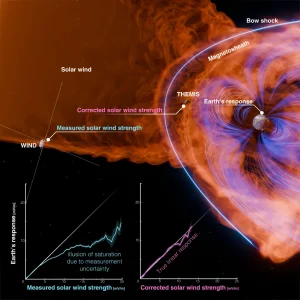
For decades, scientists have thought that there is a ceiling to how intensely Earth responds to solar storms. However, a NASA-led paper published Wednesday in Nature suggests this upper limit is an illusion. If so, it means solar storms could…