
Introduction
The flow around bluff bodies, particularly circular cylinders, is a fundamental topic in fluid mechanics due to its importance in engineering applications such as heat exchangers, offshore structures, bridge piers, chimneys, and tube banks. When fluid flows past a circular cylinder, the boundary layer separates from the surface because of an adverse pressure gradient, resulting in the periodic shedding of vortices from alternate sides of the cylinder. This repeating pattern is known as the Von Kármán vortex street.
The Von Kármán vortex street generates alternating lift forces and fluctuating pressure fields that can increase drag, produce noise, and induce vortex-induced vibrations (VIV) in structures. The onset and characteristics of vortex shedding primarily depend on the Reynolds number, which governs the balance between inertial and viscous forces in the flow.
In practical engineering applications, cylinders are often arranged in groups rather than existing as isolated bodies. The presence of neighboring cylinders modifies the downstream flow through wake interference, gap flow acceleration, and interactions between vortices. As a result, different cylinder shapes and configurations can significantly alter the wake structure, vortex shedding behavior, pressure distribution, and overall flow characteristics.
Computational Fluid Dynamics (CFD) provides an efficient method for investigating these complex flow phenomena. In this study, ANSYS Fluent was used to numerically examine the influence of different circular cylinder configurations on downstream flow behavior. By maintaining identical flow conditions for all cases, the effects of cylinder arrangement on velocity contours, streamline patterns, and wake interactions were systematically compared.
Methodology
Computational Model
The numerical simulations were performed using ANSYS Fluent in a two-dimensional (2D) computational domain to investigate the influence of cylinder configuration on downstream flow characteristics. A transient laminar flow analysis was carried out for all cases to capture the time-dependent vortex shedding associated with the Von Kármán effect.
To ensure a fair comparison between different configurations, all simulations were conducted under identical flow conditions, material properties, solver settings, and boundary conditions. Only the number and arrangement of the cylinders were varied throughout the study.
Geometry and Configurations
Each circular cylinder had a diameter of 1 m. Five different cylinder configurations were investigated:
- Single cylinder (reference case).
- Two cylinders arranged vertically, with a center-to-center spacing of 2 m.
- Two cylinders arranged horizontally (tandem), with a center-to-center spacing of 2 m.
- Three cylinders arranged in an equilateral triangular configuration, with one cylinder positioned upstream and two cylinders downstream. The edge length of the triangle was 2 m.
- Three cylinders arranged in the reverse triangular configuration, with two cylinders positioned upstream and one cylinder downstream, maintaining an equilateral triangle with 2 m edge length.
These configurations were selected to examine how different wake interactions and cylinder arrangements influence vortex formation and downstream flow behavior.
Mesh Generation
A structured computational mesh was generated for each configuration while maintaining comparable mesh quality throughout the study. Since the computational domain became more geometrically complex as additional cylinders were introduced, the total number of mesh elements increased accordingly.
The approximate mesh sizes used in the simulations were:
| Configuration | Number of Mesh Elements |
|---|---|
| Single cylinder | ~0.724 million |
| Two-cylinder configurations | ~0.781 million |
| Three-cylinder configurations | ~0.903 million |
The mesh was refined around the cylinder surfaces and within the wake region to accurately resolve boundary-layer development, flow separation, and vortex shedding.
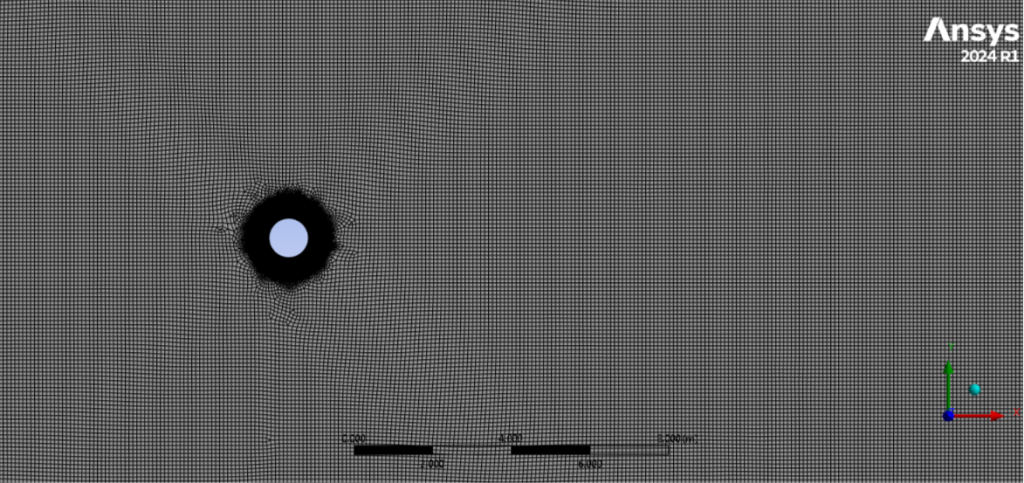
Signle Cylinder Mesh
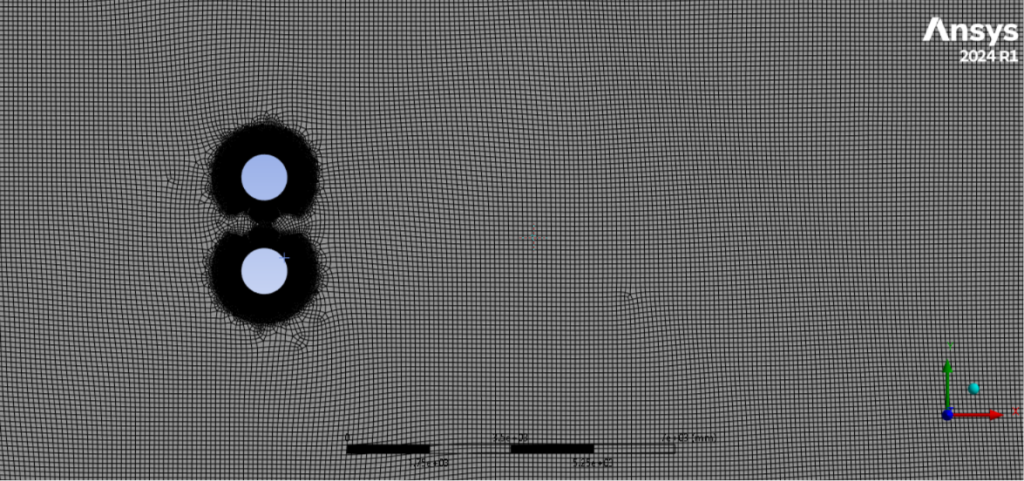
Two Cylinders Mesh
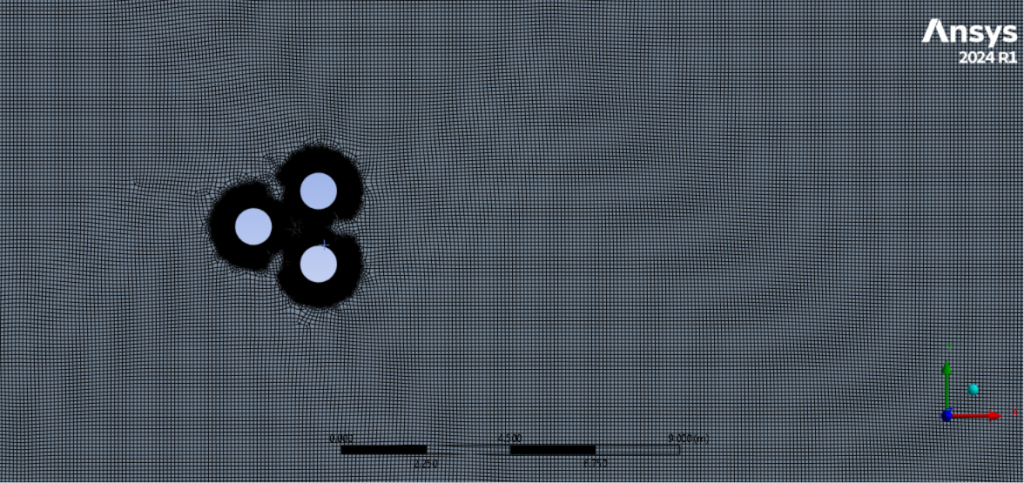
Three Cylinders Mesh
Solver Settings
The simulations were performed using the following ANSYS Fluent settings:
| Parameter | Setting |
|---|---|
| Solver Type | Pressure-Based |
| Time Formulation | Transient |
| Flow Model | Laminar |
| Spatial Dimension | Two-Dimensional (2D) |
A transient pressure-based solver was selected because the Von Kármán vortex street is an inherently unsteady phenomenon requiring time-dependent analysis to capture the periodic formation and shedding of vortices.
Fluid Properties and Flow Conditions
To simplify the numerical analysis while maintaining the desired flow regime, an idealized fluid with constant properties was employed. The fluid density and dynamic viscosity were both assigned a value of 1 (SI units). These values were chosen so that a free-stream velocity of 80 m/s produced a Reynolds number of 80 based on the cylinder diameter of 1 m.
The inlet velocity was applied in the positive x-direction with:
- Velocity (x-direction): 80 m/s
- Velocity (y-direction): 0 m/s
The Reynolds number for all simulations was calculated as:By maintaining the same Reynolds number across all configurations, any observed differences in wake structure, streamline patterns, and vortex interactions could be attributed solely to the cylinder arrangement rather than changes in the flow conditions.
Results and Discussion
The downstream flow characteristics of five different cylinder configurations were investigated under identical flow conditions at Reynolds number 80. Since all simulations were performed using the same fluid properties, boundary conditions, and solver settings, the observed differences are solely due to changes in cylinder arrangement. The comparison is based on velocity contours and streamline visualizations, which clearly illustrate how wake interference modifies vortex shedding and downstream flow development.
A. Single Cylinder
The single-cylinder case serves as the reference configuration. The flow separates from both sides of the cylinder, producing alternate vortex shedding and forming a classical Von Kármán vortex street.
Observations
- Clear alternating vortex shedding.
- Symmetric flow before separation.
- Regular sinusoidal wake extending downstream.
- Small recirculation zone immediately behind the cylinder.
Discussion
Since no neighboring body disturbs the flow, the wake develops naturally. The pressure difference between the front stagnation point and the separated rear flow creates periodic lift fluctuations responsible for the Von Kármán street. This configuration exhibits the most stable and predictable vortex shedding among all cases.
Velocity Contour
Streamline
B. Two Cylinders (Vertical Arrangement)
Introducing a second cylinder perpendicular to the flow significantly alters the wake.
Observations
- Accelerated flow through the gap.
- Wake merging immediately downstream.
- Less distinct individual vortex streets.
- Increased wake width compared to a single cylinder.
Discussion
The spacing between the cylinders creates a narrow passage, accelerating the fluid due to continuity. The resulting pressure reduction strengthens the shear layers, causing vortices from both cylinders to interact before they fully develop. Rather than producing two independent wakes, the vortices merge into a single unsteady wake. The interaction also increases local velocity gradients and enhances mixing.
Velocity Contour
Streamline
C. Two Cylinders (Horizontal/Tandem Arrangement)
The tandem arrangement produced a distinct wake pattern because the downstream cylinder was located within the wake of the upstream cylinder. Unlike the vertical configuration, the gap between the cylinders became part of the unsteady wake region.
Observations
- Streamlines intermittently pass through the gap between the cylinders.
- The gap region exhibits unstable flow behavior.
- A single elongated wake develops downstream of both cylinders.
- The downstream wake extends farther than that of the single-cylinder case.
Discussion
The wake generated by the upstream cylinder directly interacts with the downstream cylinder, creating an unsteady flow field in the gap region. Instead of a stable flow passing between the cylinders, the gap experiences periodic fluctuations as vortices are shed from the upstream cylinder. This causes streamlines to alternately pass through or deviate around the gap, indicating unstable wake behavior. The interaction suppresses the formation of two independent vortex streets, and the wake gradually merges into a single elongated Von Kármán vortex street downstream of the second cylinder. Consequently, the tandem arrangement produces a longer wake dominated by wake interference and periodic flow instability.
Velocity Contour
Streamline
D. Three Cylinders (One Upstream, Two Downstream)
Among all investigated configurations, this arrangement produced the most complex wake dynamics.
Observations
- Large recirculation region behind the cylinder group.
- Strong wake interference.
- Irregular streamline patterns.
- Highly disturbed downstream flow.
Discussion
The upstream cylinder first generates a Von Kármán vortex street, which directly impinges on the two downstream cylinders. Since these cylinders no longer experience uniform inflow, their boundary-layer separation continuously changes with time. Multiple vortex interactions occur simultaneously, preventing the formation of stable individual wakes. The resulting flow becomes highly chaotic and contains large-scale recirculating structures. This configuration demonstrates the strongest wake interaction among all cases considered.
Velocity Contour
Streamline
E. Three Cylinders (Two Upstream, One Downstream)
The reverse triangular arrangement produced a unique wake structure as the downstream cylinder was directly exposed to the flow passing between the two upstream cylinders.
Observations
- Flow passes through the gap between the upstream cylinders.
- The gap flow impinges directly on the downstream cylinder.
- A broad, coherent wake develops behind the cylinder group.
- The wake is wider than the other configurations.
Discussion
The spacing between the two upstream cylinders forms a narrow passage that accelerates a portion of the incoming flow before it reaches the downstream cylinder. This higher-velocity gap flow strikes the front surface of the downstream cylinder, while the wakes generated on either side of the upstream cylinders simultaneously interact with it. The combined effect modifies the boundary-layer separation and promotes the formation of a broader, more organized wake. Compared with the one-upstream configuration, vortex interactions occur in a more controlled manner, resulting in a coherent downstream flow despite the increased wake width.
Velocity Contour
Streamline
Limitations of this Study
Although the present numerical investigation successfully demonstrates the influence of cylinder arrangement on wake development, several limitations should be acknowledged:
- The simulations were performed in two dimensions, whereas practical flows are inherently three-dimensional.
- A laminar flow model was employed at Re = 80; higher Reynolds numbers would require appropriate turbulence modeling.
- Only one cylinder diameter (1 m) and one spacing (2 m) were investigated.
- Fluid properties were simplified by assigning unit density and viscosity to maintain a Reynolds number of 80.
- Quantitative aerodynamic parameters such as drag coefficient, lift coefficient, Strouhal number, and pressure coefficient were not evaluated.
Future work may include mesh independence studies, three-dimensional simulations, different spacing ratios, higher Reynolds numbers, and detailed force coefficient analyses.
Practical Significance
The findings demonstrate that cylinder arrangement alone can significantly alter wake structure, vortex formation, and downstream flow behavior even under identical operating conditions. This insight is valuable for the design of engineering systems where wake interaction affects structural loading, vibration, heat transfer, and flow stability.
The results are particularly applicable to:
- Heat exchanger tube bundles.
- Offshore platforms and marine risers.
- Bridge piers and cable systems.
- Chimneys and transmission towers.
- Bluff-body flow control devices.
- Flow-induced vibration (VIV) analysis.
- CFD benchmarking and engineering education.
Among the investigated configurations, the single-cylinder case provides the clearest reference for classical Von Kármán vortex shedding, the vertical two-cylinder arrangement enhances wake mixing through gap-flow acceleration, the tandem configuration produces an elongated wake due to wake shielding, the one-upstream/two-downstream triangular arrangement generates the strongest wake interference, and the two-upstream/one-downstream triangular arrangement yields the broadest yet comparatively most organized downstream wake. These observations can assist engineers and researchers in selecting cylinder arrangements depending on whether the objective is to minimize wake interaction, enhance mixing, or investigate complex vortex dynamics.