
The answer lies in a fascinating principle of fluid mechanics known as the Magnus Effect. It’s an aerodynamic phenomenon that explains how the interaction between a spinning object and the surrounding air creates a sideways force causing the object to follow a curved path.
So, what is the Magnus effect?
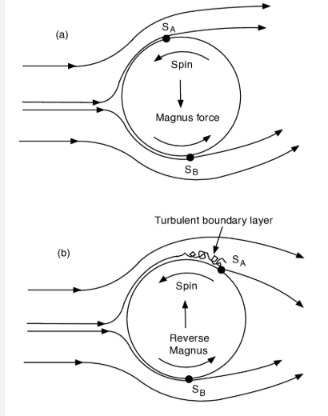
The Magnus effect is an aerodynamic phenomenon in which a spinning object moving through a fluid (such as air or water) experiences a force perpendicular to its direction of motion. This force, known as the Magnus force, causes the object’s path to curve instead of following a straight line. The Magnus Effect occurs because the spinning object changes the speed of the airflow around it.
Simple Principle of Magnus Effect
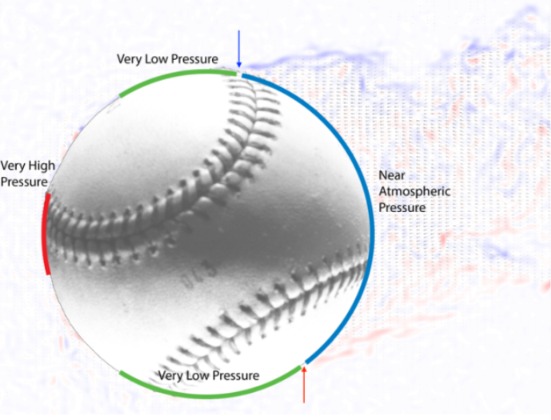
When a ball or cylinder moves through the air without spinning, the airflow around it is nearly symmetrical, producing no significant sideways force. But when the object spins, the rotation will change the airflow around its object and show asymmetrical flow. On one side of the object, this rotational drag moves in the same direction as the incoming fluid, accelerating the fluid’s speed. On the opposite side, the rotation acts against the incoming fluid, slowing it down.
According to Bernoulli’s principle, higher airflow velocity corresponds to lower pressure, while lower airflow velocity corresponds to higher pressure. This pressure variation creates a net force acting from the high-pressure side to the low-pressure side. This force is known as the Magnus force, and it causes the object to curve.
Now, let’s think about the factors which can affect the Magnus effect
- Spin rate: The rotational speed of the object is the most influential factor affecting the Magnus Effect. As the spin rate increases, the object imparts greater momentum to the surrounding air, resulting in a larger pressure difference between opposite sides of the object. Consequently, the Magnus force becomes stronger, causing a more pronounced curvature of the trajectory.
This means higher spinning causes greater Magnus force, resulting in more curve. On the contrary, lower spinning turns into a straighter path.
2. Forward Velocity: The speed of the moving object significantly influences the Magnus effect. A faster-moving object interacts with a large volume of air, increasing the pressure difference generated by its rotation. On the contrary, if the object moves too slowly, the aerodynamic forces become weak and reduce the curvature of its path.
3. Air Density: The density of the surrounding fluid determines the magnitude of aerodynamic forces acting on the object. Denser air contains more air molecules, and so it allows the spinning object to generate a larger pressure difference. Air density varies with altitude, temperature, atmospheric pressure, and humidity. For example, a football curves more noticeably at sea level than at high altitudes.
4. Object Size: During motion, the size (diameter) of the object affects the amount of air it interacts with. Larger objects have a greater surface area, which enhances the interaction between the rotating surface and the surrounding airflow. As a result, a larger object produces greater aerodynamic forces. And obviously their mass must be considered.
5. Surface Roughness: The surface of the object influences the behavior of the boundary layer. A rough surface can delay flow separation and modify the pressure distribution around the object, while a smooth surface may produce different aerodynamic characteristics. Examples: Dimples on a golf ball, seams on a baseball, seams on a cricket ball, etc. These surface features significantly affect the Magnus Effect by altering airflow around the object.
6. Fluid Properties: The Magnus Effect occurs in both gases and liquids. The properties of the surrounding fluid, such as viscosity and density, influence the interaction between the rotating object and the fluid.For example: air, water, oil, etc. Different fluids produce different aerodynamic responses.
7. Direction of Spin: The direction of rotation determines the direction of the Magnus force.
Example:
i) Top spin produces a downward force, causing the ball to dip.
ii) Backspin produces an upward force, increasing lift.
iii) Sidespin produces a sideways force, causing the ball to curve left or right.
Thus, changing the direction of spin changes the direction of the object’s curved trajectory.
8. Reynolds Number: The Reynolds number (Re) is a dimensionless parameter that characterizes the flow regime around the object. It depends on the object’s velocity, characteristic length, fluid density, and viscosity. A higher Reynolds number often leads to turbulent boundary layers, which can influence flow separation and alter the magnitude of the Magnus force.
Mathematical Representation:
The Magnus force is the aerodynamic force generated when a spinning object moves through a fluid. It acts perpendicular to boththe direction of motion and the axis of rotation, causing the object to follow a curved trajectory.
A commonly used engineering approximation for the Magnus force is the following:
FM=ρV2CLA
where:
- FM=Magnus force (N)
- ρ = Density of the fluid (kg/m³)
- V = Velocity of the object relative to the fluid (m/s)
- CL = Lift coefficient (depends on the spin rate and Reynolds number)
- A = Reference area of the object (m²)