

What Is a Fluid?
You will recall from physics that a substance exists in three primary phases: solid, liquid, and gas. (At very high temperatures, it also exists as plasma.) A substance in the liquid or gas phase is referred to as a fluid. Distinction between a solid and a fluid is made on the basis of the substance’s ability to resist an applied shear (or tangential) stress that tends to change its shape. A solid can resist an applied shear stress by deforming, whereas a fluid deforms continuously under the influence of shear stress, no matter how
small. In solids stress is proportional to strain, but in fluids stress is proportional to strain rate. When a constant shear force is applied, a solid eventually stops deforming, at some fixed strain angle, whereas a fluid never stops deforming and approaching a certain rate of strain.

Consider a rectangular rubber block tightly placed between two plates. As the upper plate is pulled with a force F while the lower plate is held fixed, the rubber block deforms, as shown in Fig. 1–2. The angle of deformation a (called the shear strain or angular displacement) increases in proportion to the applied force F. Assuming there is no slip between the rubber and the plates, the upper surface of the rubber is displaced by an amount equal to the displacement of the upper plate while the lower surface remains stationary. In equilibrium, the net force acting on the plate in the horizontal direction must be zero, and thus a force equal and opposite to F must be acting on the plate. This opposing force that develops at the plate–rubber interface due to friction is expressed as F = A, where t is the shear stress and A is the contact area between the upper plate and the rubber. When the force is removed, the rubber returns to its original position. This phenomenon would also be observed with other solids, such as a steel block, provided that the applied force does not exceed the elastic range. If this experiment were repeated with a fluid (with two large parallel plates placed in a large body of water, for example), the fluid layer in contact with the upper plate would move with the plate continuously at the velocity of the plate no matter how
small the force F is. The fluid velocity decreases with depth because of friction between fluid layers, reaching zero at the lower plate.
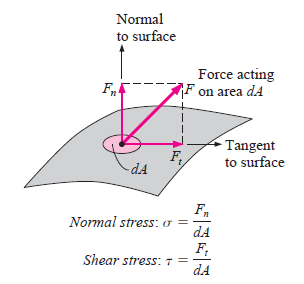
You will recall from statics that stress is defined as force per unit area
and is determined by dividing the force by the area upon which it acts. The normal component of the force acting on a surface per unit area is called the normal stress, and the tangential component of a force acting on a surface per unit area is called shear stress (Fig. 1–3). In a fluid at rest, the normal stress is called pressure. The supporting walls of a fluid eliminate shear stress, and thus a fluid at rest is at a state of zero shear stress. When the walls are removed or a liquid container is tilted, a shear develops and the liquid splashes or moves to attain a horizontal free surface.


How can I reach you?