
An orifice meter is a flow measuring device that is very popular among other flow measuring instruments due to its design simplicity, cost efficiency and easy manufacturability to determine the discharge in single and multi-phase flow. This section will focus on the structure of an orifice meter and calculation method of coefficient of discharge of a given fluid (water). Orifice meter is used to measure the flow rate of any gas or liquid (fluid).
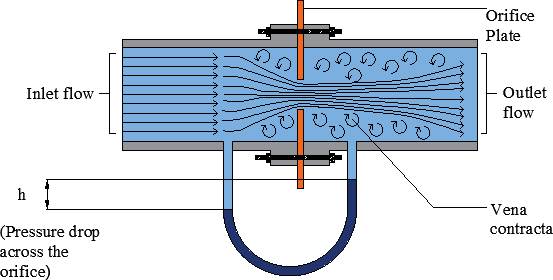
Figure 1. Structure of an orifice meter.
This is a combination of multiple main parts such as orifice plate, differential manometer, orifice plate housing, downstream pipe, upstream pipe etc. For the study of fluid mechanics, we often require properties like coefficient of discharge, coefficient of velocity, coefficient of contraction etc. Orifice meter plays a vital role in calculating such coefficients.
The Orifice meter measures the manometric pressures of both sides of its plate and by using Bernoulli’s equation necessary data are extracted. It operates on the principle that the drop of pressure of fluid after passing the orifice plate is related to the flow rate. Measuring this pressure drop, fluid flow rate through a pipeline can be determined. This is widely used in industrial applications for fluid flow measurements.
To measure the flow rate of the fluid, the governing equation is:

Where the constant is defined by the apparatus geometry and fluid properties:

For a given fluid, the relationship between discharge and head is expressed as:

Where the flow constant is:

Here,
: Rate of flow / Actual discharge (
or
)
: Coefficient of discharge
: Orifice area (
)
: Deflection in the manometer (Differential Head)
: Specific gravity of manometric fluid (e.g., Mercury)
: Specific gravity of flowing fluid (e.g., Water)
: Coefficient of contraction
: Orifice diameter (
)
: Pipe diameter (
)
: Flow constant (
)
: Exponent index (slope of the log-log plot)
: Acceleration due to gravity (
)
By taking the logarithm of the discharge and head relation, we obtain:

Plotting versus
on a graph yields a straight line. The slope of the line (
) is calculated using two data points (
and (
) from the graph:


Subtracting the equation (6) from the equation (7):

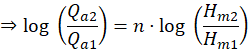

Using these equations the value of n and Cd can be obtained.